One year ago, attorney and author Karen McMullin published a “community memoir” describing how her small Montana town recovered from a tragic shooting in 2003. The book, Love Wins: A True Story of Tragedy, Heroes, and Healing has received robust positive reviews regionally and nationwide. Scroll to the end of the interview for the book’s jacket description and purchase link.
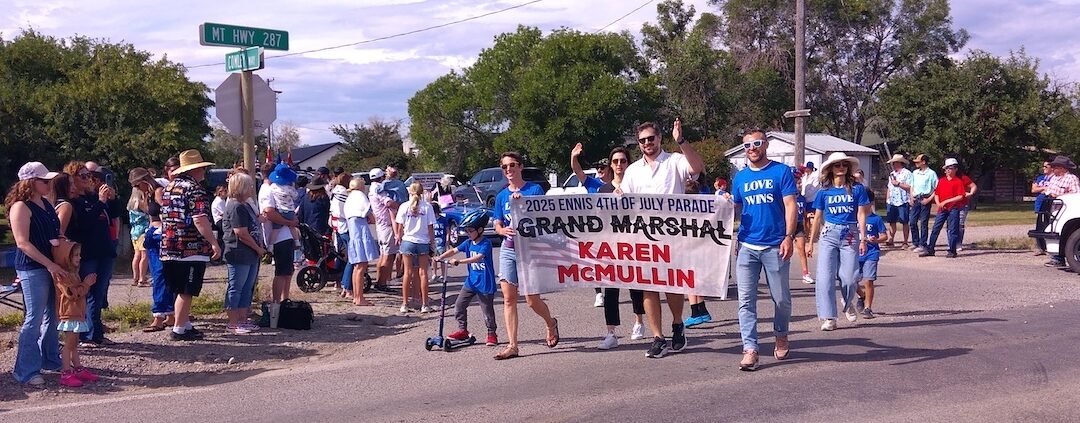
In July 2025, the town of Ennis, Montana honored Karen for her work on this book, inviting her to serve as Grand Marshal in the renowned Ennis Fourth of July Parade. The small town of about a thousand people welcomes 5,000 to 10,000 guests on parade day.
Anika Hanisch was involved as a developmental editor and line editor for Karen’s book. Anika and Karen connected this year to discuss the unique challenges of writing a memoir that recalls the experience of an entire community.
An Interview with Karen McMullin
Anika Hanisch: When did you originally think of writing this book, and when did you begin work on it?
Karen McMullin: The whole year after the tragedy (2003-2004), I knew there should be a book about our town’s recovery. I wasn’t sure I would write it; I was always watching for a book to come out. I began the actual research, the interviews, when I retired about five years ago. Then, a couple years ago, in 2023, there was a flurry of social media activity, people chiming in with their memories. Twenty years after tragedy, people were sharing their memories.
Anika: I remember that. All that discussion confirmed the need for this book. When you began your research, who did you interview first?
McMullin: One of the first interviews was Sharon Clark, the mother of Jamie (the young man who died the night of the shooting). That was the hardest interview. I didn’t know her well, so I was nervous to reach out to her. I don’t remember why, but I surely did reach out to the people I didn’t know first. Maybe it was to get the hardest interviews done first!
But Sharon was so immediately wonderful. She came to me with armfuls of files and newspaper clippings. With Sharon, if she had said, “Get out of here, I don’t want this,” that might have been the end of the project. Her opinion of the project was that important to me.
Many of the interviews, I would just dread reaching out. But never was anyone horrific. Only one person didn’t want to be interviewed. I had to stand on his porch and knock on his door, holding a draft for him to read.
Anika: I remember that too. One of the survivors was, and is, understandably a very private person. He probably didn’t want to relive that night.
McMullin: Yes, Mike. I was communicating with his sister on Facebook messenger. She gave me current contact info for him. I went to his front porch to give him a really rough draft chapter that mentioned him. The draft was based on what others had said about him, and I wanted to make sure he was okay with what I’d written. No one came to the door, so I put the draft on his porch and left a note saying, “If you object to any of this, please reach out to me.”
Then I waited. I never heard back. I was just that terrified of a bad reception from him. I was so, so worried because there’s this scene of Jason saving Mike’s life. I was worried he wouldn’t want that scene in there; it’s so private.
Anika: Yes, and you tried reaching out to him again later on, right? When that section had gone through further editing and revision?
McMullin: Yes, I physically went to his home again, after leaving more material for him to look at. That time, his wife answered the door with their baby. Then he came to the door too. I still didn’t know if he read it. But he said, “Wow you’re really doing this!” He gave me a hug. I was so relieved. Finally, when the book was published, I brought him a signed copy. He was so excited. Then he came to the book signing we had at our local grocery store and I got another hug. Then he came to the 4th of July parade, where we were waiting to begin, with his wife, her friend and their baby. He asked if they could follow along behind me in my parade car. Oh yes, they could! It was very affirming to know he was okay with the book.
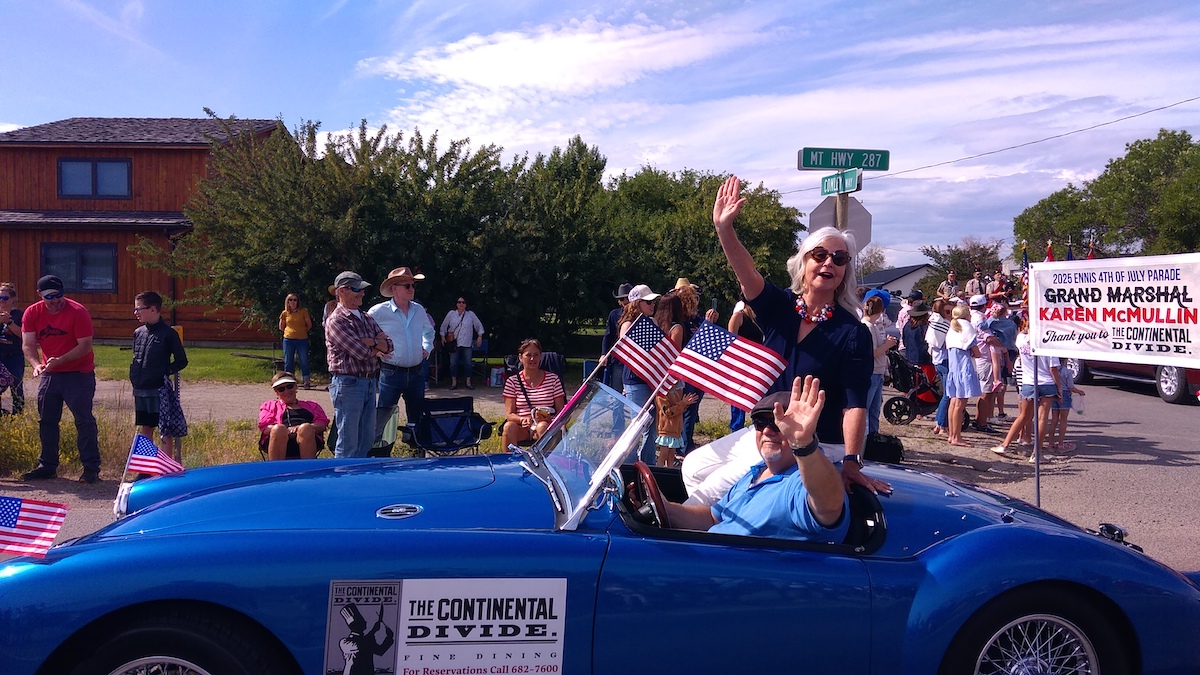
To thank her for writing the book Love Wins, McMullin was asked to be the 2025 Grand Marshal for the Ennis Montana Fourth of July Parade the
Anika: You interviewed a wide range of people, from EMS workers and police, to the shooting survivors themselves, and they all had a wide range of responses to your interview requests—from quiet refusal to providing extensive material.
McMullin: Yes, like Gavin. I sent the manuscript drafts to him, communicated with him many times, and got so much written material from him. The last time we connected, I got a text from him. The book was published, and I’d sent him a copy. He said he opened the cover, saw his quote on the first page, and he “cried like a baby.”
Trett is another one who was very forthcoming and cooperative. We emailed only, never spoke. That was easier for him because he has a really busy life with work and raising his own family now.
I mailed or handed hard cover, inscribed copies to all the survivors. I don’t know if all of them have actually read the book. I wouldn’t ask that of them. But, apart from one, everyone agreed to an interview.
Anika: That’s honestly pretty surprising. It’s far more common in this literary space for people to refuse such interviews. No one wants to re-live that kind of trauma. It’s a real sacrifice to provide such an interview. Did you ever run into anyone who didn’t want the book written?
McMullin: Only after it was already published. The parents of one of the people who witnessed the shooting, came to a book signing. I greeted them from my table, and the wife put her hand up and said, “I’m never going to read your book!”
My daughter was there and was upset about the encounter. I said, “Hey we don’t know what this book is going to trigger.” People are different. How am I to know how this will affect each person in the community?
Anika: Not everyone will be happy about something that might feel like it’s poking at old wounds. It won’t feel like a good thing for every member of your community.
McMullin: Right. But Sharon Clark, I hadn’t seen her for a while. I got a thankful text from her when she received her copies of the book. Then I went to The Hunter’s Feed (an annual celebration in Ennis). We were walking along, and all of a sudden there was this person giving me a huge hug. I didn’t realize who it was at first. It was Sharon! She was just so happy with the book. I think it gave her a feeling that her son is memorialized in our town; he won’t be forgotten. The town surely gave her that message years ago with the memorial, but the book cements that feeling.
Thinking of Dave Clark (no relation to Sharon Clark), during our interview he teared up and, after I left, he texted me. He said he felt like something had gotten off his shoulders. He’s a tough guy; he’s been in law enforcement for years. Now he owns a heavy equipment business in town. But people needed to talk about what happened. Nurses and the Nurse Practitioner said that also. They carried that night inside them. For years, they couldn’t talk about it because of medical confidentiality. The book project allowed them to speak; it was a release for them too.
Anika: I’m sure there were some survivors who felt that way. Some didn’t want to talk about it, but for others, it was good to finally share about the tragedy.
Karen: Yes, like Angie (one of the young people who was chased by the shooter). She had never been able to share with her family and friends and husband the true and whole story of what happened to her. To have it written with the whole timeline, it was cleansing for her. To let loved ones read this, but she didn’t have to formulate it herself. She’d always felt angry about the whole thing, and had the overwhelming feeling that help did not arrive fast enough. After reading the book, for the very first time, she had an overview of everything that happened that night. Once she got the full timeline from the book, she had a tremendous relief that everyone did the very best they could.
Anika: What was it like to listen to such hard stories over and over? You conducted dozens of interviews.
Karen: As an attorney all those years, I have those skills. But later on, processing the stories, putting them into writing, that affected me. I really struggled with a lot of the writing, staying awake at night thinking, “Should I be doing this, revealing this?” On my morning walks, I was always wrestling, wondering, “Should I write this?” and wrestling with each scene
Listening to so many divorce and child custody and child abuse cases when I was an attorney, I have pretty thick skin. But this was different. It was hard to try to guess what this book would do to other people.
Anika: Did you run into any other complications after the book came out? Anything you’d want aspiring authors to know about?
Karen: (laughing) Figuring out how many people get copies of the book. It’s a small community and so many are mentioned in the book.
Anika: In all seriousness, that’s a really interesting challenge. When you write a community memoir, does that put the author under any obligation to provide free signed copies for everyone mentioned, or just the people who gave of their time during interviews? That’s something to keep in mind if you’re thinking of writing a community memoir.
Karen: Yes, I had to limit it to people I interviewed and characters who were mentioned by name and key to the story.
Anika: Do you have any other advice for aspiring memoirists or biographers who will need to conduct a lot of research for their projects?
Karen: Do it. Because you’ll complete one of the most satisfying projects in your whole life. Get a fabulous editor like I did! That will take the book to the next level.
Other than that, you have to be brave. To break through “I can’t do this,” and think instead, “I CAN reach out to this person I don’t know well or never met.” Don’t worry about the consequences right now. Don’t imagine the consequences. Just start.
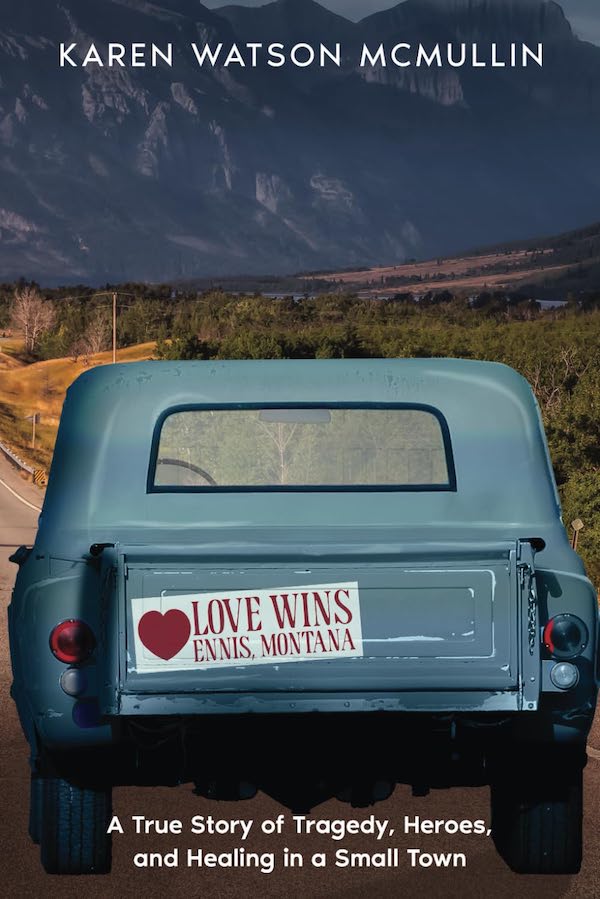
Love Wins: A True Story of Tragedy, Heroes, and Healing in Small Town Montana (McMullin, 2024) is available on Amazon and wherever fine books are sold.
Ennis, Montana – Population 864. On an early summer night in 2003, a group of young friends in a small Montana town gathered for a night out. But their summer celebration soon turned into a nightmare.
Throughout the evening, a sullen stranger had verbally harassed them. They were grateful when the man finally left around closing time. Then George Davis returned carrying a gun. He opened fire, wounding six and killing one. News coverage at the time focused on the police chase that led to Davis’ capture. But little light was ever shined on what really happened to the young people and the town. This is their story.
Love Wins is a tender portrait of community recovery. It recounts the heroic acts of civilians, EMTs, police, and small-town hospital staff. Then it highlights how the Ennis community wrapped its arms around the survivors and the grieving family for months and years to come. The people of this small mountain town are a living definition of the best of humanity, when confronted with the worst. Their actions remind us of the heroism, selflessness, and generosity we all can show to our fellow human beings. Their story confirms that when the unfathomable occurs, survival depends upon living among people who care.